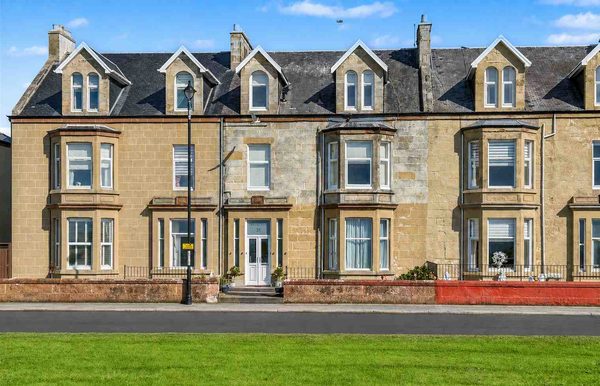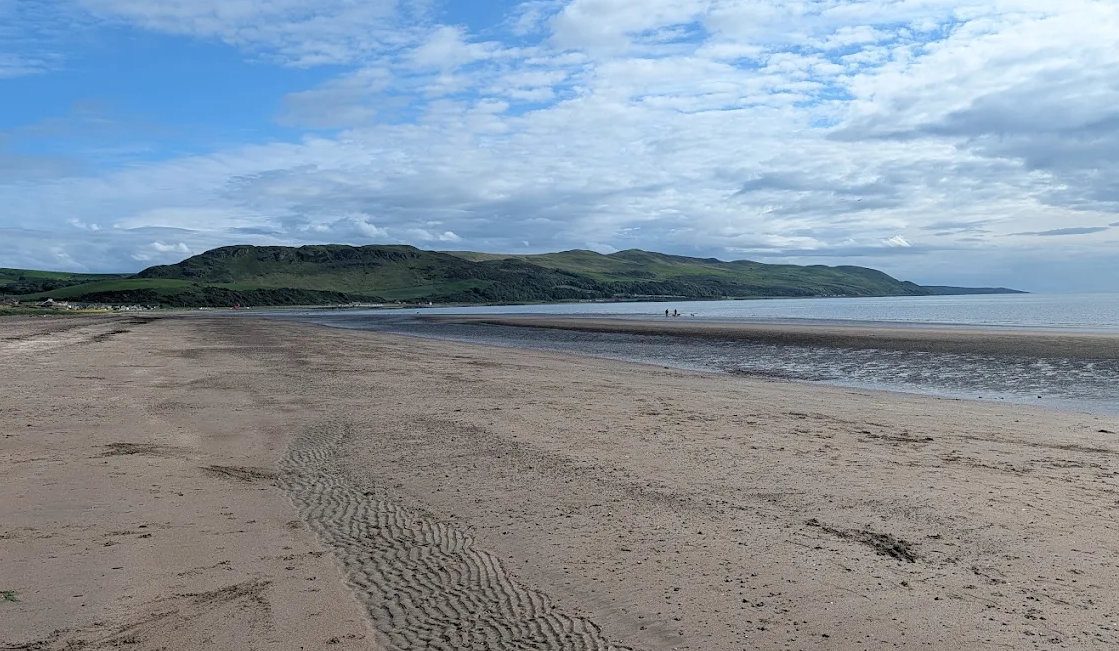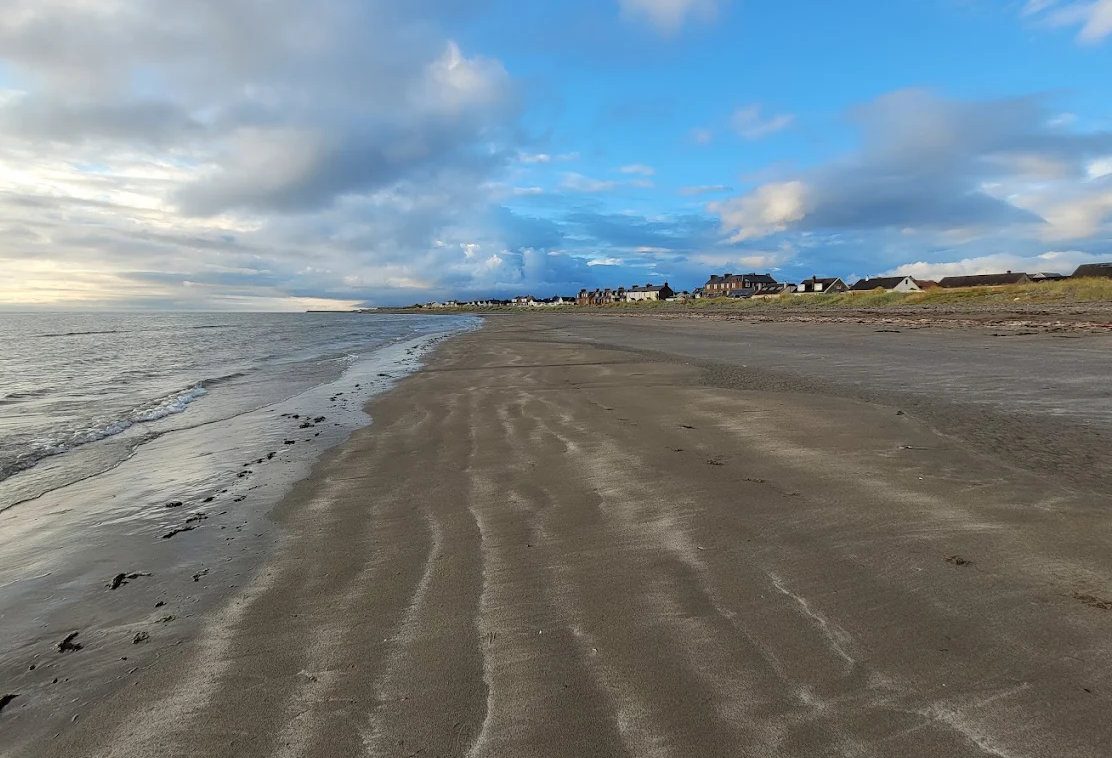
Whithorn is a single broad street of painted houses on the Machars, the blunt peninsula that hangs off the bottom of Galloway below Wigtown. It is about fifty miles from Girvan, an hour each way, and it is the most historically important place within a day's drive of the apartment by a distance.
Beneath and behind that street is the oldest Christian site in Scotland. Three miles further on, at the end of the road, is the Isle of Whithorn, which is a different place with a different character and is not an island.
What the archaeology has done to the St Ninian story
The traditional account runs like this: St Ninian founded a church here around AD 397, built in white stone and known as Candida Casa, the shining white house, and from it converted the southern Picts.
Almost none of that survives contact with modern scholarship, and the honest version is more interesting.
There is no written reference to Ninian from his own lifetime. The Whithorn Trust, which runs the visitor centre here, says so plainly on its own website: he is "a shadowy figure in history". The earliest surviving mention is Bede, writing around 731 — roughly three hundred years after the fact.
Work by Thomas Owen Clancy and James Fraser argues that the name itself is a mistake: the historical figure behind it was probably Uinniau, miscopied by a scribe as Nyniau. The life of the saint appears to have been written around 720 to 730, quite possibly at Hexham in Northumbria rather than at Whithorn at all, as ecclesiastical politics — a way of asserting Roman orthodoxy and legitimising a new bishop's seat. A good deal of what people now repeat about Ninian, including the episode at Tours, was added by Aelred of Rievaulx in the twelfth century.
The date 397 has no documentary basis either. It is a commemorative date, and the Whithorn Trust is careful to say it is celebrated rather than recorded.
The archaeology has moved too. Research by Adrián Maldonado of National Museums Scotland and Shirley Curtis-Summers of the University of Bradford re-dated the human remains excavated in the 1980s. Their conclusion is that Whithorn in its earliest Christian phase was not a monastery. It looks like a power centre, perhaps a ceremonial meeting place for Christian elites, with imported French wine, fine glass, exotic herbs and spices, and evidence of feasting. The earliest burials of a recognisably monastic type are seventh century.
You will still find the traditional story on interpretation boards and in official records, including Canmore's own entry, which is a useful reminder that records lag the scholarship.
The Latinus Stone
This is the thing to come for.
The Latinus Stone is a memorial of about AD 450, and Historic Environment Scotland calls it the oldest surviving Christian memorial in Scotland. Its inscription begins Te Dominum laudamus — we praise you, the Lord — and commemorates Latinus, aged 35, and his daughter, aged 4, descendants of a man named Barravados.
Latinus is the earliest known named Christian in Scotland. It is worth standing in front of that for a minute.
The dating is stylistic rather than scientific, resting on the early six-armed Constantinian form of the chi-rho, the Roman lettering and the Roman name. The stone was found in 1891, having been reused at some point as building material in the walls of the medieval cathedral. It is now in the priory museum.
The museum also holds the Monreith Cross, at over three metres the tallest known cross in Galloway, dated somewhere between the ninth and eleventh centuries and probably carved from sandstone brought in from the West Highlands because it works better than the local greywacke. It broke in the 1600s and is still incomplete.
There is a whole "Whithorn School" of carving, emerging around the mid-900s in the Norse period, with elaborate interlace. Eighteen carved stones from St Ninian's Cave are in this museum, not at the cave.
The priory
In 1128 Fergus of Galloway had a bishop appointed at Whithorn and installed Augustinian canons. Around 1175 they were replaced by Premonstratensians, the white canons, and it is largely their work that stands.
They built a great cross-shaped church on the site of the earlier one, and it became the cathedral church of the diocese of Galloway. What survives is the west end of the nave, standing, plus vaulted crypts at the east end which held St Ninian's shrine.
Around 1500, under James IV's patronage, a large chapel was added and the crypts enlarged, specifically to handle the volume of pilgrims.
The Pend, the late medieval archway from George Street into the precinct, carries royal heraldic panels. The Whithorn Trust describes these as one of only four Stuart coats of arms of this quality in Scotland, though we have not been able to corroborate that claim independently.
At the Reformation in 1560 the monastery was suppressed and St Ninian's shrine destroyed.
Pilgrimage, and the kings who came
Whithorn was Scotland's principal shrine, and the documentary evidence for royal pilgrimage here is unusually good.
- 1302 — the future Edward II visited while commanding occupying forces.
- 1329 — Robert the Bruce made a long and painful journey here seeking a cure, three months before he died.
- 1427 — James I issued a decree of safe conduct for pilgrims travelling to Whithorn from England and the Isle of Man. That is an act of state, and it is the firmest evidence of organised international traffic.
- James IV came at least once a year over many years, which is known because his Treasurer kept the accounts. It was his favourite pilgrimage.
- 1511 — James IV's charter made Whithorn a royal burgh.
Pilgrimage here was not always devotional. Criminals could be sentenced to seek forgiveness at the shrine.
Some of the better stories are explicitly legendary and the Trust flags them as such, including the tale of the saint's image returning by itself from Sweetheart Abbey.
The modern Whithorn Way is a waymarked route of about 155 miles from Glasgow, developed by the Whithorn Trust from 2017 with lottery and Scottish Government funding. The Trust is careful to say it follows much of the western pilgrim route. It is a modern path over a documented medieval corridor, not a rediscovered Roman road, and it is worth saying so. It passes Crossraguel Abbey and one of its stages ends in Girvan.
The Isle of Whithorn
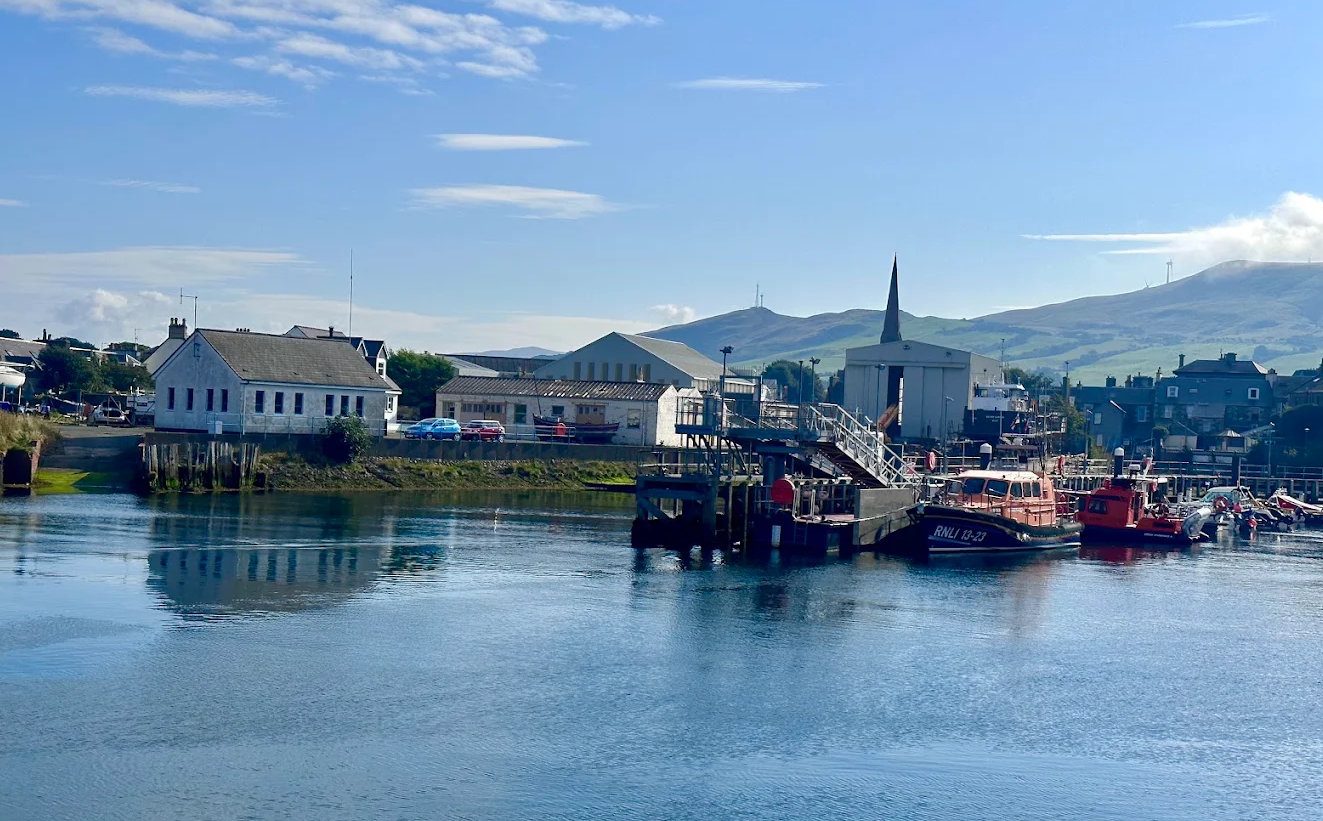
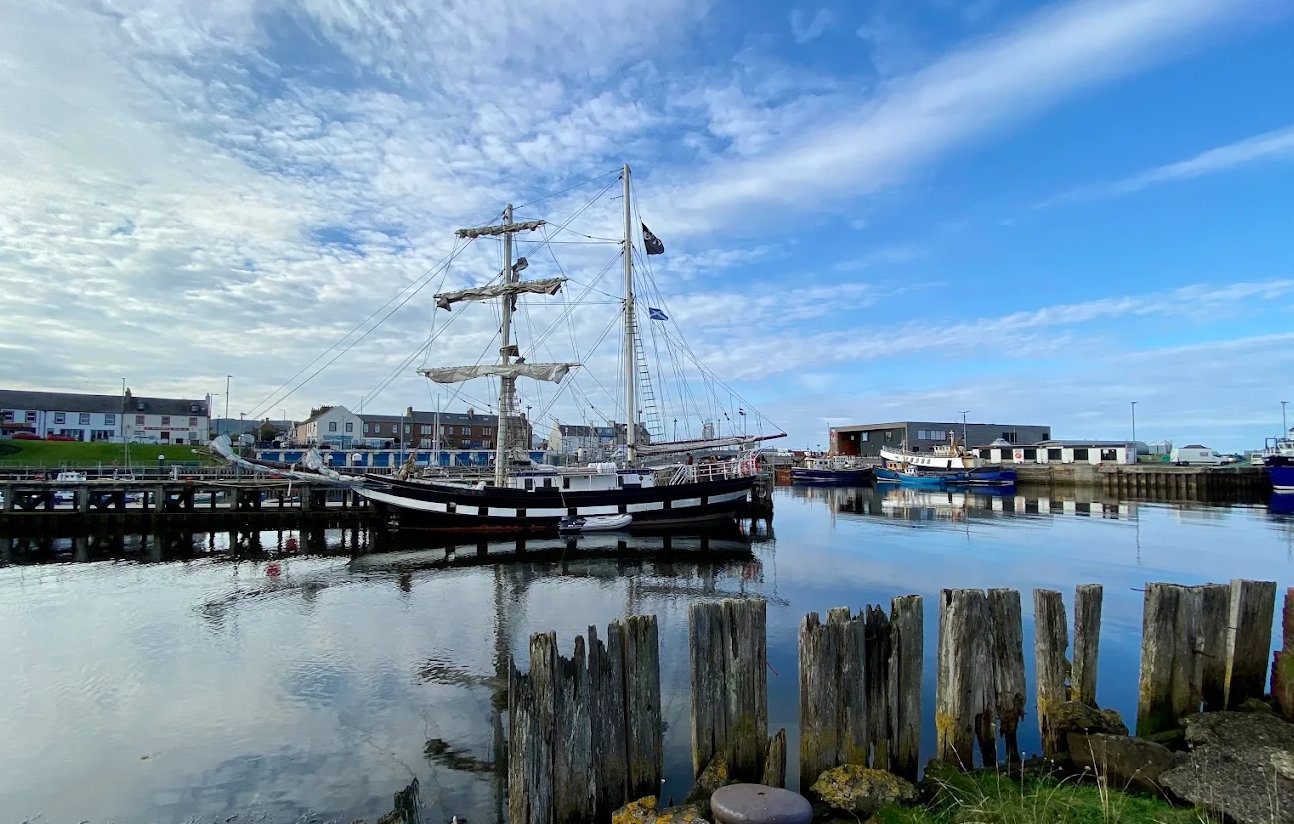
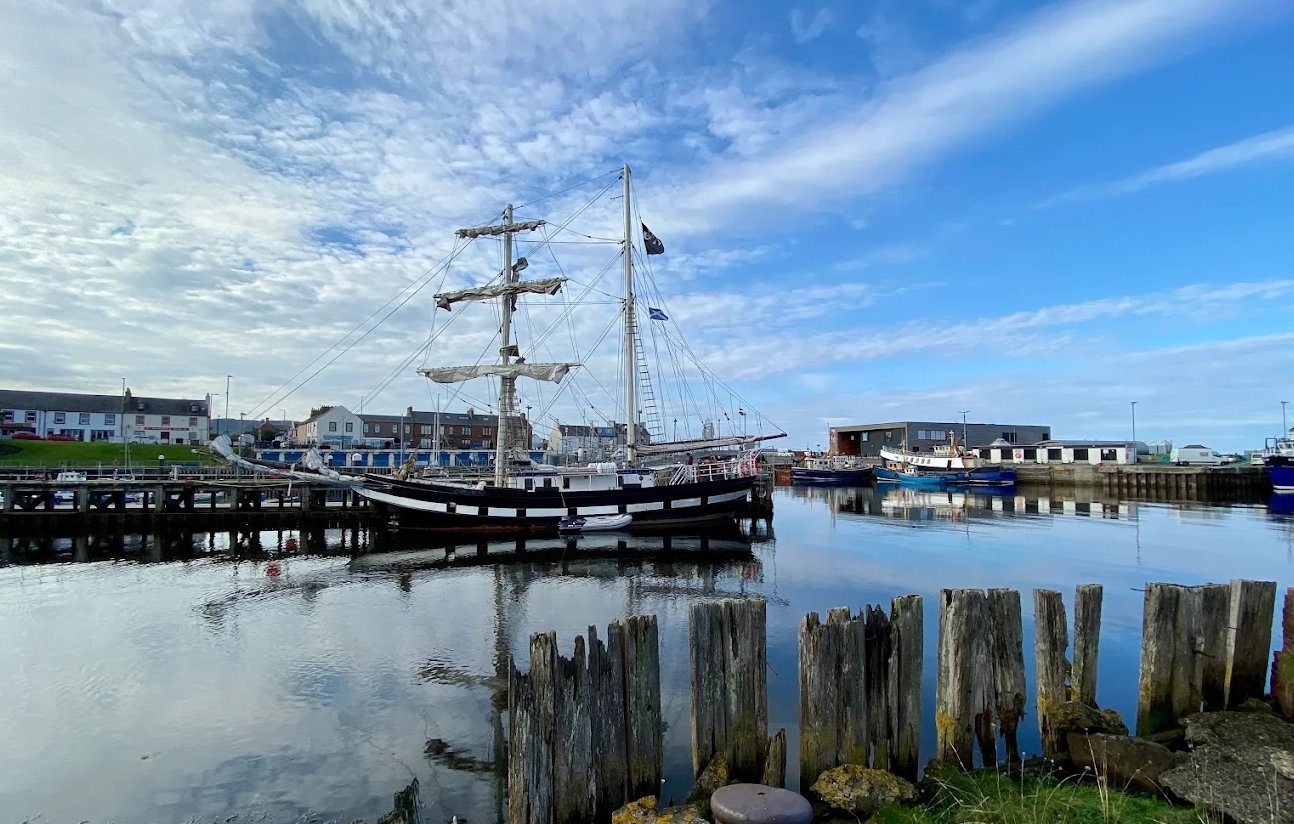
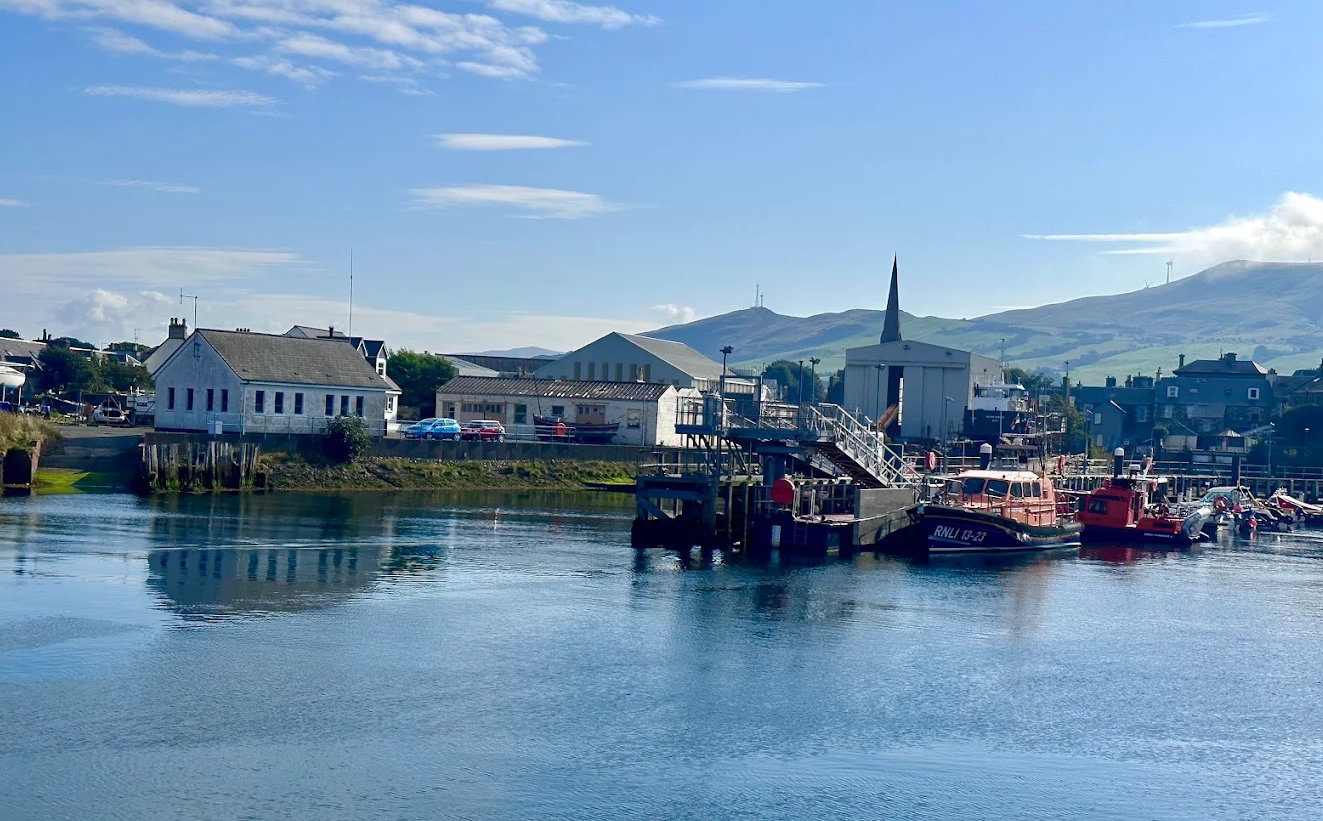
Three miles on, and a different place: a working harbour village at the end of the road.
It is not an island. Harbour improvements in 1790 built the causeway that joined it to the mainland. The harbour itself is Category B listed, sixteenth century in origin and largely rebuilt in 1790, with millstones from Bysbies Mill set into the landward section and cast-iron capstans on the seaward arm. There was trade with Whitehaven and with Sweden by 1760.
St Ninian's Chapel stands above the shore, roofless and free to visit at any time. The dating needs care: the standing ruin is about 1300, and excavation found the foundations of an earlier chapel of the twelfth or early thirteenth century beneath it. Both dates get quoted and both are right about different buildings. It was repaired and partly rebuilt in 1898 by the Marquess of Bute. It probably served the port and pilgrims arriving by sea from Ireland and Man.
The Witness Cairn nearby is modern, inaugurated in 1997 for the supposed 1600th anniversary, and visitors add a stone to it.
The Solway Harvester
On 11 January 2000 the scallop dredger Solway Harvester sank south-east of the Isle of Man. All seven crew died. Three were from the Isle of Whithorn and the others from Whithorn and Garlieston. The official investigation found that water entered through open ice scuttles in the fish room, that the bilge alarm was not working, and that the crew had minutes of warning at most.
Two memorials of Galloway granite stand on Isle Head, near the chapel: a rough-hewn seat and a boulder topped with an anchor, both carrying the seven names. They are not a sight to tick off. In a village of this size, seven is most of a generation of its young men.
Getting there and practicalities
About fifty miles from Girvan and an hour each way, down the A714 through Newton Stewart and then south. Public transport is not realistic as a day trip: it runs to two and a half or three hours each way with changes. Whithorn's own railway station, Scotland's southernmost, closed in 1950.
The priory nave is open all year and free. The museum and crypts are seasonal — roughly April to October, and unusually closed on Saturdays, with a lunchtime closure in the middle of the day. From November to March they shut altogether.
The Whithorn Story visitor centre on George Street, run by the Whithorn Trust, opens a similar season, also closed Saturdays, and includes a guided tour of the reconstructed Iron Age roundhouse. A combined ticket covers the museum, crypts, centre and roundhouse: adult £7.50, concession £6.00, child £4.50 at the time of writing. Historic Environment Scotland members get the priory and museum free but pay extra for the roundhouse.
Two things to check by phone before you travel, on 01988 500700:
- The crypts. Historic Environment Scotland lists them as included; the Whithorn Trust's own opening page has said they are closed to the public. We could not resolve the contradiction.
- St Ninian's Cave at Physgill, four miles out and one of the most recommended things to do here, was listed by Historic Environment Scotland as closed for conservation work with no reopening date given. It would be a wasted drive.
The museum is step-free. The priory nave is not — every entrance has at least one step and is approached across grass on a slope. The crypts have historic stone steps, a gravel floor and very little natural light.
Whithorn town has a population of about 750, and Dumfries and Galloway Council's own plan for the town names closed shops and declining town-centre activity among its problems. Do not expect a tourist high street. The history is the reason to come.