Maybole sits nine miles north of Girvan on the A77, and for several centuries it was the most important town in Carrick. The National Library of Scotland's own background to the Victorian town plan puts it plainly: from the eleventh century until the Union of the Crowns, Maybole was for all practical purposes the capital of the Earldom of Carrick.
That was never a legal title. What it meant was that the Kennedys ran Carrick as hereditary bailies, and Maybole is where they did it from.
About those 28 lairds' houses
You will read everywhere, including on this page until recently, that Maybole had 28 lairds' houses on its High Street in the 1500s. We went looking for the source of that and could not find one.
What actually circulates is a different claim: that in 1686, or the late seventeenth century, the town held the town houses of 28 lords and landowners with estates in Carrick and beyond. Not houses on one street, and not the 1500s. The trail appears to lead back to William Abercrummie, minister of Maybole, whose description of Carrick was written around then, but we could not read the text to check it.
So: treat the 28 as a traditional figure, usually dated to 1686, repeated far more often than it has been verified. The underlying point stands regardless. This was where the county families wintered, and the town was built accordingly.
Maybole Castle
The Category A listed building on the High Street, with its corbelled angle turrets and conical caps, was the town mansion of the Earls of Cassillis.
Its date is genuinely disputed and the gap is wide. Historic Environment Scotland's statutory listing says probably the first quarter of the seventeenth century, probably built for John, 6th Earl. Canmore suggests it may date to around 1540 under Gilbert, the 3rd Earl, citing a "new house of Maybole" recorded in 1545 and a "tower, manor place and fortalice" in 1584. Tourism sources tend to say about 1560. There is no reconciling these, and anyone who gives you a single confident date is picking one.
For a long time it was used as the estate offices of the Cassillis and Culzean estates, which is why a working office block kept the name castle. It remains in estate ownership. The Buildings at Risk Register records water ingress and dry rot, with the ground and first floors in use and the upper floors vacant.
In December 2021 around £730,000 was awarded to convert it into an "Enterprising Carrick Hub", with restored gardens intended to open to the public. Construction started in February 2023 with completion stated as spring 2024.
We cannot tell you whether that finished. The regeneration project's own website appears to have stopped being updated in mid-2023, and when the council announced a new round of funding in March 2026 it listed the town hall, Goudie's and a community hub among its achievements and did not mention the castle. Treat it as a building to admire from the street until someone tells you otherwise.
The collegiate church, and why you cannot get in
St Mary's, the "Auld College", on Abbot Street. A chapel was established here in 1371 by Sir John Kennedy of Dunure and raised to collegiate status about 1381, staffed by a provost, two chaplains and a clerk praying in perpetuity for the founder and his family. Historic Environment Scotland's scheduled monument record gives 1382 for the foundation within a pre-existing chapel, so even the official records disagree by a year or two.
What survives is substantial: most walls near their original height, decorated windows with flowing tracery, and dog-tooth moulding on the doorways and on a tomb. The Kennedy earls of Cassillis used it as their burial place into the late 1600s, and mass was still being publicly celebrated here in 1564, four years after the Reformation, by a congregation of two hundred.
Knox and the Abbot, 1562
For three days in November 1562, John Knox debated the mass in Maybole with Quintin Kennedy, the last Abbot of Crossraguel, with forty witnesses on each side.
This is not a local legend. The transcript was printed the following year in Edinburgh, and copies survive. The debate settled nothing: Kennedy went on celebrating the Catholic mass at Crossraguel until his death in 1564.
It happened in the house of the provost of the collegiate church, later the Red Lion Inn, on what became John Knox Street. The building that carried the name was demolished in 1963 — and it is worth knowing that specialists had already doubted whether it was the original, since the standing structure looked early nineteenth century and a stone dated 1649 was found in the ruins next door. There is a marble plaque on an end-terrace house, and nothing else.
The bypass, and what it changed
The A77 Maybole bypass opened on 31 January 2022: five kilometres, £29 million. Before that, the trunk road from Glasgow to the Cairnryan ferries ran straight down the High Street, and around one vehicle in ten on the A77 is a lorry. Transport Scotland's own case for the scheme cited restricted footpath widths and pedestrian safety as much as congestion.
The difference in the town centre is immediate and obvious. It is a pleasant place to stand still in now, which it was not.
The bypass was also the trigger for a rebuild. A partnership between Maybole Community Council and South Ayrshire Council drew in more than £8 million from the Scottish Government, the National Lottery Heritage Fund, Historic Environment Scotland, Sustrans and others, including a Conservation Area Regeneration Scheme grant.
The clearest result is the Town Hall. A sixteenth-century tower converted to a tolbooth in 1674 by the 7th Earl of Cassillis, extended in 1887 in Scottish Baronial, it had £1.145 million spent on it and reopened in October 2023 as a community events venue. Goudie's on Whitehall, a bar, café and restaurant in the former Speakers club run by a community leisure charity, opened in May 2021 and was the first project completed.
In March 2026 the council launched a further £2 million programme: £250,000 for shopfront improvements, £125,000 to bring three council-owned buildings on School Vennell back into a fit state to occupy, and £600,000 for Greenside, the space between the High Street and the station.
Read that honestly. A second multi-million round, including money to make council buildings safe enough to use, is not what a thriving high street needs. No one publishes a vacancy rate for Maybole, so we cannot give you a figure, but the population is about 4,300 and has fallen 9% since 2011, station usage has dropped by roughly a quarter since 2022/23, and the Old Parish Church on Cassillis Road has stood roofless since a fire in July 2015, on the Buildings at Risk Register at high risk. The town is being worked on hard, and it needs to be.
There is history behind that. By 1891 Maybole had ten shoe factories employing 1,500 people, turning out something like a million pairs a year. The trade collapsed, people emigrated around 1910, and some of them founded a district in Ontario they called Wee Maybole.
What to actually do
On foot, from the station. Four waymarked walks all start at the town green at Greenside, opposite the railway station, which makes Maybole one of the easiest car-free walking days from Girvan. The Kildoon Circuit is the pick: 8 km, up Kildoon Hill to the Fergusson obelisk and back. There is also Drummochreen Cairn (15.3 km), a circular to Kirkoswald taking in Souter Johnnie's Cottage, Crossraguel and Baltersan Castle (21 km), and a linear walk to Dunure (11.3 km), which needs transport planning at the far end.
In the town. Maybole Castle from the street, the restored Town Hall, the Knox plaque on John Knox Street, the collegiate church from the boundary, and the burnt-out Old Parish Church. That is a good ninety minutes of looking.
Eating. Goudie's on Whitehall is the confirmed option, and it is a community-run business worth supporting. Otherwise it is chip shops and takeaways.
Parking. One council car park, Kirk Wynd, KA19 7AE, free.
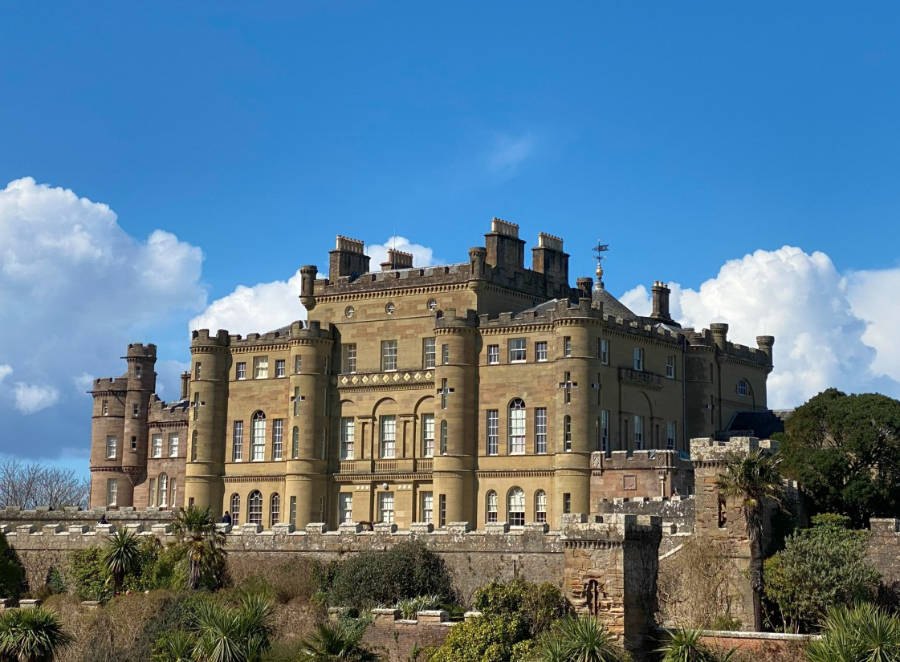
Nearby. Crossraguel Abbey two miles south-west — but note it opens April to September only, Thursday to Sunday, and is ticketed. Culzean four miles west, whose postal address is Maybole and which will eat a whole day on its own. Kirkoswald and Souter Johnnie's Cottage.
A warning about stacking. Crossraguel's four-day week and Culzean's short castle opening make it very hard to do the abbey, the castle and the town in one half day. Pick two.
Burns, and a correction
It is often said that Robert Burns's parents were married in Maybole. They were not — William Burnes and Agnes Broun married in Ayr on 3 December 1757.
The real Maybole connections are better anyway. Agnes Broun was sent to Maybole in 1744 to live with her grandmother Jean Rainie, who was steeped in Scottish songs and ballads and passed them on to her. And the couple are thought to have first met at Maybole Fair in 1756. The poet's ear for a ballad has a plausible route back to this town.
Getting there
Nine miles from Girvan on the A77, or by train: both towns sit on the Ayr to Stranraer line, and the station puts you within a hundred metres of the town green where the walks start. Maybole to Ayr is twelve minutes with up to fourteen trains a day; the Girvan direction is thinner, so check before relying on it. Stagecoach service 360 links Ayr, Maybole, Culzean, Kirkoswald, Girvan and Stranraer, but the frequency is low enough that a return needs planning.