For several years Crossraguel was largely fenced off. It was caught up in Historic Environment Scotland's national high-level masonry programme, which closed seventy properties across Scotland for hands-on inspection of their high stonework, and for a long stretch visitors could only walk the grounds and look at the ruins from behind a barrier. That has changed. The abbey reopened in stages, and at the time of writing you can get into the cloisters, the nave, part of the choir, the chapter house, the cellars where the carved stones are displayed, and up the gatehouse stair.
Conservation work is still going on, and some areas remain shut: the high altar at the east end of the choir, the sacristy, the inner court and the doocot. That list has moved more than once and it will move again, so treat it as a snapshot rather than a fixture.
Why it is worth the trip
Most Scottish abbeys give you a magnificent church and not much else. Melrose, Dryburgh, Sweetheart — you stand in a roofless nave and imagine the rest.
Crossraguel is the other way round. The church is relatively modest. What survives is the machinery of the place: the chapter house where the monks met every morning, the sacristy, the abbot's tower house, the gatehouse, the doocot, the precinct wall, the outer court and the footings of a row of small houses. Historic Environment Scotland's own designation record calls it one of the most complete large monastic complexes to have survived. You can walk it and read the whole plan on the ground, which is a rarer thing than a tall gable.
It is a scheduled monument (first scheduled in 1921) and separately Category A listed.
The founding, and a fifty-year argument
The monks were Cluniac, a reformed Benedictine congregation answering to the great abbey of Cluny in Burgundy. Paisley and Crossraguel were the only two Cluniac houses in Scotland, which is the first thing that makes this place unusual.
The founding is a better story than the usual pious donation. Around 1215, Duncan of Carrick, later Earl of Carrick, granted lands and churches to Paisley Abbey on the condition that Paisley establish a daughter house in Carrick. Paisley took the income and built a small chapel instead.
It took a lawsuit. In 1244 the Bishop of Glasgow's court ordered the monks of Paisley to build a proper abbey at Crossraguel, put monks in it, and let it have abbots of its own. Paisley appealed to the Pope in 1265 and lost. The community does not seem to have been working properly until the later 1200s, and the first recorded abbot appears around 1286.
Sources differ on what to call the foundation date as a result. Historic Environment Scotland's visitor material says the early 1200s, its own statement of significance says the second half of the thirteenth century, and Canmore calls the date uncertain. The honest version is the sequence above rather than a single year.
The name is older than the abbey. It is generally read as the cross of Riaghail — St Regulus, or Rule — which suggests an early Christian cross stood here before any monk arrived.
Bruce, and the rebuilding
As Earl of Carrick, Robert the Bruce was the abbey's patron, and the monks stayed loyal to him. It cost them. The abbey was targeted and badly damaged during the Wars of Independence, and the thirteenth-century cruciform church was largely destroyed. Only the two western angles of the nave really survive from it.
What you see instead is the rebuild: a plain rectangle of nave and choir with no transepts, put up in the fourteenth century, along with the east and south ranges of the cloister and the abbot's house.
Then, in the second half of the fifteenth century, Abbot Colin Kennedy rebuilt the east end properly and gave it an elegant polygonal apse. The sacristy and chapter house were rebuilt in the same century, and those two rooms are the reason to come.
What to look for
- The chapter house. The stone benches the monks sat on are still in place, with an arched seat for the abbot. These are not reconstructions. The room is also known for its acoustics.
- The polygonal apse, the fifteenth-century set piece at the east end. Note that the high altar area itself is currently fenced.
- The gatehouse, sixteenth century, and you can climb it. The stair is a stone spiral with no handrail, which is worth knowing before you start up.
- The carved stones in the cellars.
- The tower house at the south-east corner, home of the last abbots and then of the commendators. Canmore dates it to about 1530; Historic Environment Scotland suggests it may be late fifteenth century.
- The doocot, two-storey and sixteenth century. Awkwardly, it is one of the features HES itself singles out as making the abbey special, and it is one of the things currently roped off.
- The row of five small houses along the south wall of the outer court, and here the official records genuinely disagree. HES reads them as evidence that the monks were eventually allowed to live individually, contrary to their original rule of communal living. Canmore calls them corrodians' houses — lodgings for lay pensioners who had bought board and keep from the monastery. They are the same footings and the two readings are not the same claim. Nothing we found settles it.
The roasting of the Commendator
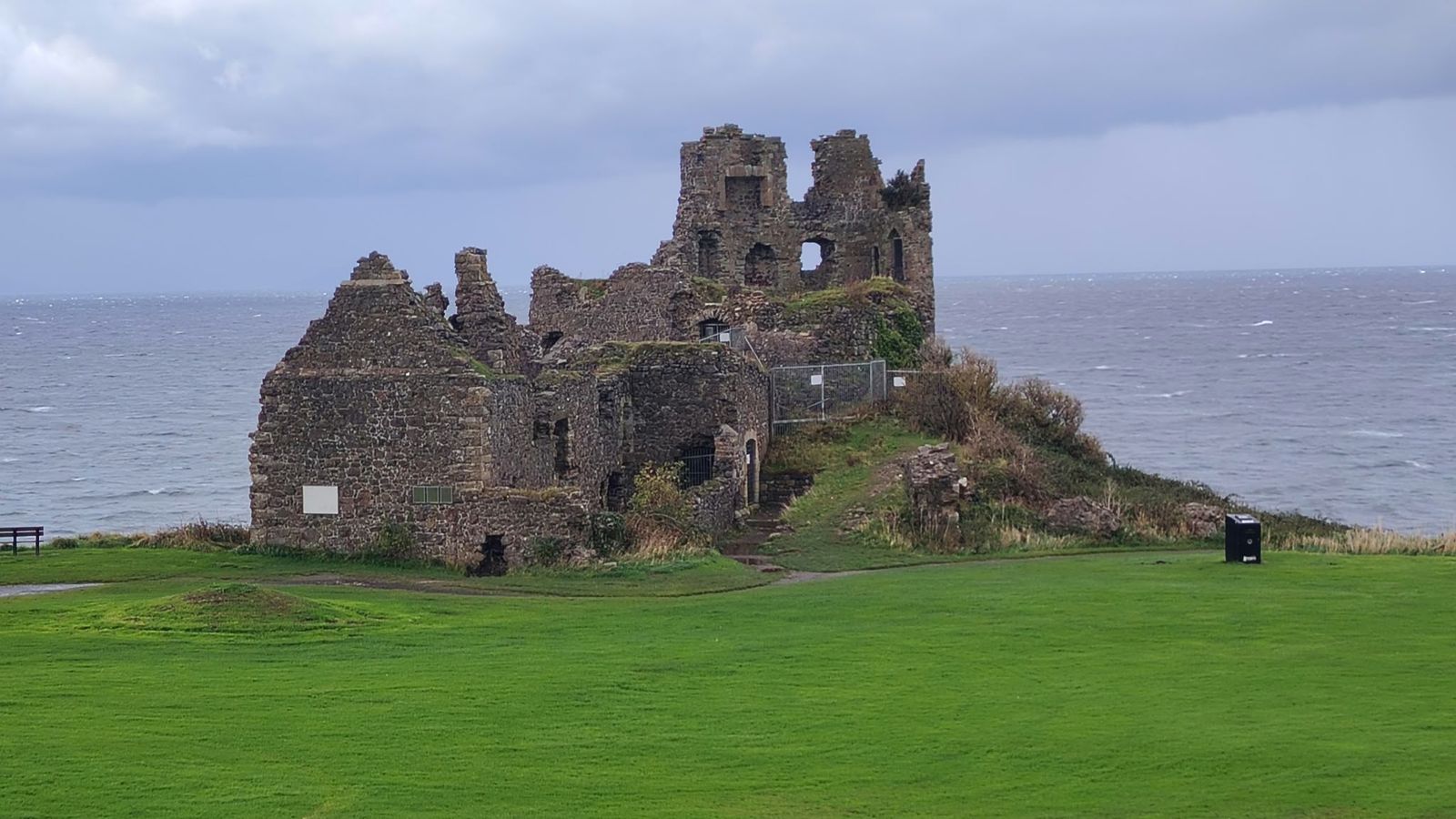
The story everyone repeats happened in 1570, and the first thing to say is that it did not happen here. It happened at Dunure Castle, about eight miles away on the coast.
Gilbert Kennedy, 4th Earl of Cassillis, wanted the abbey's lands. Allan Stewart, the Commendator of Crossraguel — a lay holder of the revenues after the Reformation — would not sign them over. Kennedy had him seized in the woods near the abbey, got him to Dunure by deception, and had him roasted over a brazier in the vault there, twice, with the Earl's own cook and baker assisting.
Stewart was rescued by Thomas Kennedy of Bargany, his brother-in-law and the head of the rival Kennedy line, who had helped deliver him in the first place and then changed sides. Bargany stormed Dunure and took Stewart to Ayr, where at the town cross he revoked the lease and denounced the Earl. Stewart complained to the Privy Council.
This is not folklore. It is recorded in the memorials of Richard Bannatyne, who was John Knox's secretary, so it rests on a near-contemporary account rather than a tradition.
What we cannot tell you is how it ended. It is widely written that the Earl was made to apologise and to pay Stewart a pension for life, and that Stewart never walked again. We have not been able to trace any of that to an authoritative source, and one account says plainly that Cassillis was never fully brought to book. What is clear is that the Kennedys of Cassillis got the land, and that a feud ran on for decades afterwards. Treat the tidy moral ending with suspicion.
You will also see the year given as 1565 and 1569. 1570 is the best supported, but it is not secure.
The end of it
Crossraguel came through the Reformation of 1560 better than most. The records say it was partly destroyed by reformers in 1561, but that monks remained in occupation until 1592 — more than thirty years after the Reformation. One account says the last monk died in 1601. We could not resolve which is right.
The last true abbot was Quintin Kennedy, who died in 1564 and who in 1562 spent three days debating the mass with John Knox at Maybole, two miles up the road, with forty witnesses on each side. The transcript was printed the following year, so unlike the roasting it is documented beyond argument.
After him came commendators rather than abbots. In 1617 the revenues were annexed to the bishopric of Dunblane. The abbey passed into state care in 1913, with consolidation work running to 1924.
Visiting
Eighteen minutes from Girvan on the A77, about two miles south-west of Maybole, postcode KA19 8HQ. It is directly on the road north, so it is a natural stop rather than a detour.
There is a level tarmac car park at the gate, with coach parking. On site there are toilets, a shop, a picnic area and a water refill point. There is no adapted toilet here — the nearest is in Maybole, which is the sort of thing that can spoil a day out if you find it out on arrival.
The main routes round the monument are gravel or grass, firmer in dry weather, and several rooms have a step at the entrance. The visitor centre is step-free.
Book online. It is cheaper than paying at the gate at every price tier. Historic Environment Scotland members go free.
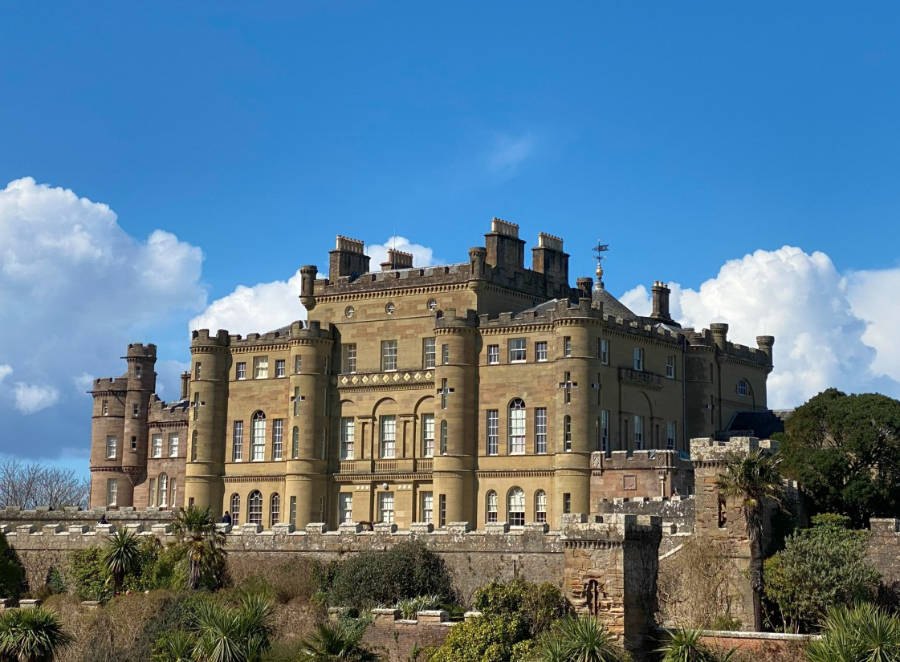
Allow about an hour. It sits neatly between Culzean and Kirkoswald on a Carrick heritage day, though be careful about stacking it with Culzean, which will absorb most of a day on its own.
One last thing for walkers. Crossraguel stands on the Whithorn Way, a modern waymarked pilgrim route from Glasgow to Whithorn, and the stage that takes in the abbey is the one that ends in Girvan. It is a modern route rather than a rediscovered medieval road, but it passes the gate.